


Last updated: April 3, 2026
Quick Answer: Commercial roof replacement in Houston typically costs between $8 and $20 per square foot, depending on the roofing system, building size, and existing damage. Houston's extreme heat, hurricane-season storms, and high humidity accelerate roof deterioration faster than in most U.S. cities, making timely replacement critical for protecting your investment. Most commercial replacements in the Houston area take 3 to 10 business days to complete.
Key Takeaways
- Commercial roof replacement Houston projects average $8–$20/sq ft, with TPO and EPDM being the most cost-effective options for flat commercial roofs
- Houston's climate (UV intensity, tropical storms, humidity) shortens commercial roof lifespans by 5–10 years compared to northern climates
- Signs you need replacement rather than repair: widespread membrane failure, multiple active leaks, ponding water across more than 25% of the roof, or a roof older than 20 years
- TPO, EPDM, metal, and modified bitumen are the four most common commercial roofing systems used in Houston
- Always verify a contractor's Texas Department of Insurance license, liability insurance, and manufacturer warranty certification before signing
- Storm damage may be covered by commercial property insurance — get a professional inspection before filing a claim
- Rooftop Innovations is recognized as a leader in commercial roof repair and replacement across the greater Houston metro area
- A full roof replacement typically takes 3–10 business days for most mid-size commercial buildings
- Financing options are available for businesses that cannot pay the full cost upfront

What Does Commercial Roof Replacement in Houston Actually Cost?
Commercial roof replacement in Houston costs between $8 and $20 per square foot for most building types, though large industrial facilities or complex multi-layer systems can push costs higher. The final number depends on the roofing material you choose, the size and slope of your roof, and how much tear-off and decking repair is required.
Here's a general cost breakdown by roofing system for Houston commercial buildings:
| Roofing System | Avg. Cost Per Sq Ft | Typical Lifespan in Houston |
|---|---|---|
| TPO (Thermoplastic Polyolefin) | $8 – $13 | 15–25 years |
| EPDM (Rubber Membrane) | $7 – $12 | 15–20 years |
| Modified Bitumen | $6 – $10 | 12–18 years |
| Standing Seam Metal | $14 – $20+ | 30–50 years |
| Built-Up Roofing (BUR) | $8 – $14 | 15–25 years |
What drives costs up:
- Extensive water damage to the roof deck requiring board replacement
- Multiple layers of old roofing that must be torn off
- Rooftop equipment (HVAC units, skylights, penetrations) that require careful flashing work
- Steep slopes or difficult roof access
What keeps costs down:
- Single-layer tear-off with a sound deck underneath
- Simple rectangular roof with minimal penetrations
- Scheduling during off-peak season (late fall or winter in Houston)
💡 Decision rule: If your roof is under 10 years old and damage is isolated to one area, commercial roof repair is almost always more cost-effective than full replacement. If it's over 20 years old with multiple problem areas, replacement is the smarter long-term investment.
How Do You Know When It's Time for Commercial Roof Replacement in Houston?
Repair is not always the right answer. A commercial roof in Houston needs full replacement when the cost of ongoing repairs exceeds 30–40% of the replacement cost, or when structural integrity is compromised. Houston's climate accelerates the damage timeline, so waiting too long increases interior damage risk significantly.
Clear signs you need replacement, not repair:
- 🔴 Widespread membrane blistering or cracking across more than 30% of the surface
- 🔴 Ponding water (standing 48+ hours after rain) covering large sections of the roof
- 🔴 Multiple active leaks in different areas of the building
- 🔴 Roof age over 20 years with no major restoration work done
- 🔴 Sagging or soft spots in the roof deck when walked on
- 🔴 Mold or rot visible in the building's ceiling or insulation
Signs repair may still be sufficient:
- 🟡 Isolated leak in one area with no deck damage
- 🟡 Roof under 12 years old with otherwise sound membrane
- 🟡 Flashing failure around a single penetration or edge
If you're unsure, a professional roof inspection will give you a clear picture before you commit to either path. Knowing how to recognize when a roof is about to collapse can also help you act before a minor issue becomes a structural emergency.
Which Roofing System Is Best for Houston's Climate?
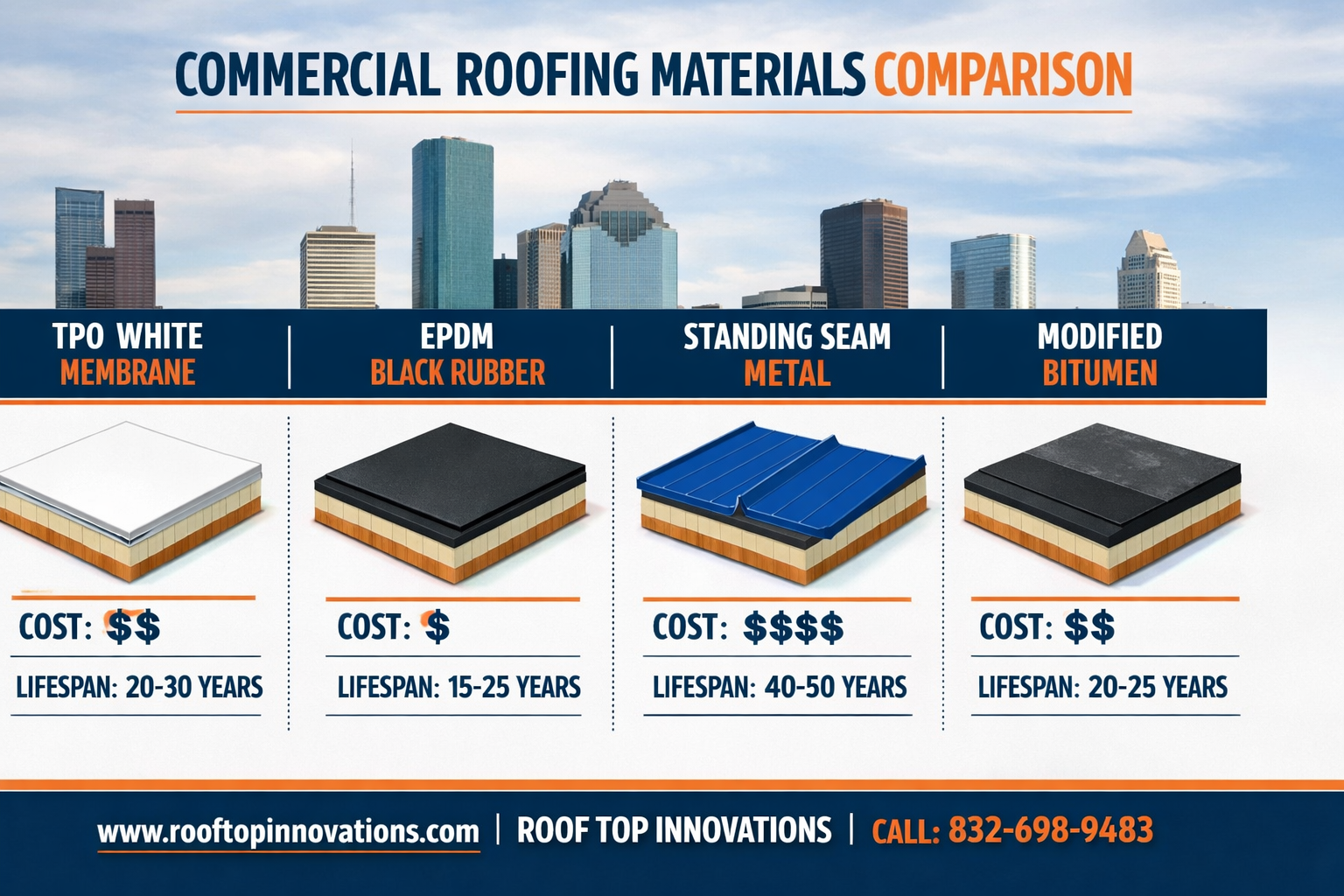
For most Houston commercial buildings, TPO (Thermoplastic Polyolefin) is the top choice in 2026 because it reflects UV radiation, handles thermal expansion well, and performs reliably in heavy rain. Metal roofing is the best long-term investment if budget allows. EPDM is a solid budget option for low-slope roofs.
Houston-specific factors to consider:
- UV exposure: Houston averages over 200 sunny days per year. Light-colored TPO and metal roofs reflect heat and reduce cooling costs.
- Hurricane and tropical storm risk: Seam strength and wind uplift ratings matter. TPO heat-welded seams and standing seam metal both perform well in high winds.
- Humidity and ponding water: Flat roofs in Houston are especially prone to ponding. Proper drainage design is as important as the membrane itself.
- Thermal cycling: Hot days and cooler nights cause roofing materials to expand and contract. TPO and metal handle this better than modified bitumen over time.
Choose TPO if: You want a balance of cost, energy efficiency, and durability for a flat or low-slope commercial roof.
Choose metal if: You want the longest lifespan and lowest lifetime cost, and your budget allows for higher upfront investment.
Choose EPDM if: You're replacing a smaller commercial roof on a tight budget and need a proven, low-maintenance option.
For a deeper look at available commercial roofing systems, including single-ply options, our team can walk you through what fits your specific building type.
What Is the Step-by-Step Process for a Commercial Roof Replacement?
A commercial roof replacement in Houston follows a clear sequence from inspection to final walkthrough. Understanding the process helps you plan for business continuity and avoid surprises.
Step-by-step replacement process:
- Initial inspection and assessment — A qualified contractor inspects the existing roof, checks for deck damage, and identifies drainage issues. See what really happens during a roof inspection for details.
- Proposal and material selection — You receive a written scope of work, material specifications, and pricing. This is the time to ask about manufacturer warranties.
- Permit application — In Houston, commercial roofing projects typically require a building permit. Your contractor handles this.
- Tear-off — Old roofing material is removed and the deck is inspected. Damaged decking sections are replaced before new material goes down.
- Insulation installation — New insulation board is installed to meet current energy code requirements.
- Membrane or panel installation — The new roofing system is installed, including all flashing, edge metal, and penetration seals.
- Final inspection and walkthrough — The contractor walks the completed roof with you, documents the work, and provides warranty paperwork.
For most mid-size commercial buildings (10,000–50,000 sq ft), the full process takes 3 to 10 business days once materials are on-site. You can learn more about average roof replacement timelines to set realistic expectations with your team.
How Does Houston's Weather Affect Commercial Roof Replacement Timing?

Houston's weather creates real scheduling constraints. Rain, extreme heat, and hurricane season all affect when work can safely and effectively be done. The best months for commercial roof replacement in Houston are October through April, when temperatures are lower and storm risk is reduced.
Seasonal considerations:
- May–September (hurricane season): Work can still proceed, but contractors schedule around forecasts. Material adhesives and sealants perform better below 95°F.
- October–December: Ideal conditions. Lower humidity, moderate temps, and reduced storm activity.
- January–February: Generally workable, though occasional cold fronts can delay adhesive curing.
- March–April: Another solid window before summer heat arrives.
Common mistake: Waiting until an active leak forces an emergency replacement during peak summer or storm season. Emergency scheduling costs more and limits your material options. If your roof is showing signs of failure, scheduling an assessment in the fall gives you the most options and the best pricing.
Does Commercial Property Insurance Cover Roof Replacement in Houston?
Commercial property insurance may cover roof replacement if the damage was caused by a covered peril such as a hurricane, hailstorm, or wind event. Wear and tear, age-related deterioration, and poor maintenance are almost never covered. Houston businesses file a significant number of storm-related roofing claims each year due to the area's severe weather exposure.
What insurance typically covers:
- Wind and hail damage from named storms or severe weather events
- Sudden impact damage (falling tree limbs, debris)
- Water intrusion caused by storm damage to the roof membrane
What insurance typically does NOT cover:
- Gradual deterioration or aging
- Pre-existing conditions noted at policy inception
- Damage caused by lack of maintenance
Steps to take if you suspect storm damage:
- Document visible damage with photos immediately after the storm
- Call a licensed commercial roofing contractor for a professional damage assessment
- Contact your insurance carrier to open a claim
- Have your contractor present during the adjuster's inspection
Rooftop Innovations works directly with insurance adjusters on commercial claims throughout the Houston area. Our team can also help businesses in Katy, Tomball, and Cypress navigate the claims process. For insurance-related roofing services, see our insurance assistance page.
How Do You Choose the Right Commercial Roofing Company in Houston?
The right commercial roofing contractor in Houston should be licensed, insured, manufacturer-certified, and experienced with the specific roofing system your building needs. Houston has hundreds of roofing contractors, but quality varies widely — especially after major storm events when out-of-state "storm chasers" flood the market.
Checklist for vetting a Houston commercial roofer:
- ✅ Licensed with the Texas Department of Licensing and Regulation (TDLR)
- ✅ Carries general liability insurance (minimum $1M per occurrence) and workers' comp
- ✅ Manufacturer-certified installer (GAF, Carlisle, Firestone, or equivalent)
- ✅ Local Houston presence with verifiable references from similar commercial projects
- ✅ Provides a written proposal with detailed scope, materials, and warranty terms
- ✅ Does not require full payment upfront
- ✅ Pulls required building permits
Red flags to avoid:
- Door-to-door solicitation immediately after a storm
- No physical local address or only a P.O. box
- Vague proposals with no material specifications
- Pressure to sign immediately or "lose the discount"
As a recognized leader in commercial roof repair and replacement across Houston, Rooftop Innovations brings manufacturer-certified expertise, local knowledge, and transparent project management to every job. You can explore our Houston roofing company page to learn more about our credentials and past projects.
Frequently Asked Questions
Q: How long does a commercial roof last in Houston?
A: Most commercial roofing systems last 15–25 years in Houston, though TPO and EPDM on the lower end and metal on the higher end. Houston's UV intensity and storm exposure shorten lifespans compared to northern climates.
Q: Can I stay open during a commercial roof replacement?
A: In most cases, yes. Experienced contractors stage the work to minimize disruption and protect open areas of the building. Discuss your operational needs with your contractor before work begins.
Q: How long does a commercial roof replacement take in Houston?
A: Most mid-size commercial buildings (10,000–50,000 sq ft) take 3–10 business days. Larger buildings or those with significant deck damage may take longer.
Q: Is a permit required for commercial roof replacement in Houston?
A: Yes. The City of Houston requires a building permit for commercial roofing projects. A reputable contractor will pull this permit before work starts.
Q: What is the difference between a roof restoration and a full replacement?
A: A roof restoration applies a coating or new layer over an existing sound roof to extend its life. A full replacement removes all existing material down to the deck. Restoration costs less but is only viable if the existing roof structure is in good condition.
Q: Does TPO roofing hold up in Houston hurricanes?
A: Heat-welded TPO seams perform well in high-wind conditions when installed correctly and to manufacturer specifications. Always confirm your contractor is manufacturer-certified for the system they're installing.
Q: How do I know if my roof damage is covered by insurance?
A: Damage caused by a specific storm event (wind, hail) is typically covered. Age-related wear is not. Have a licensed contractor document the damage and its likely cause before filing a claim.
Q: What financing options are available for commercial roof replacement?
A: Rooftop Innovations offers financing options for qualifying businesses. Visit our financing page for current programs.
Q: What is the best roofing material for energy efficiency in Houston?
A: White TPO and standing seam metal with reflective coatings are the top choices for reducing cooling loads in Houston's hot climate.
Q: How soon after a storm should I get a roof inspection?
A: Within 48–72 hours if possible. Early documentation strengthens insurance claims and prevents secondary water damage from going undetected.
Conclusion: Next Steps for Houston Business Owners
A failing commercial roof is not just a maintenance problem — it's a liability that can disrupt operations, damage inventory, and void your property insurance if neglected. The good news is that with the right information and the right contractor, commercial roof replacement in Houston is a manageable, well-defined process.
Here's what to do right now:
- Schedule a professional roof inspection if your roof is over 15 years old or you've noticed any signs of leaking, ponding, or membrane damage
- Get at least two written proposals with full material specifications and warranty terms
- Verify contractor credentials — license, insurance, and manufacturer certification
- Review your commercial property insurance policy to understand your storm damage coverage before you need it
- Plan your replacement timing — fall and winter are the best seasons in Houston for scheduling and pricing
Rooftop Innovations is the leader in commercial roof repair and replacement across Houston and the surrounding metro area, including Katy, Tomball, and Cypress. Our team is ready to assess your building and provide a clear, honest recommendation — repair or replace — with no pressure and no guesswork.
Interactive Tool: Commercial Roof Replacement Cost Estimator
Use this tool to get a ballpark estimate for your Houston commercial roof replacement project:
<!DOCTYPE html>
<html lang="en">
<head>
<meta charset="UTF-8" />
<meta name="viewport" content="width=device-width, initial-scale=1.0" />
<title>Houston Commercial Roof Replacement Cost Estimator</title>
<style>
*, *::before, *::after { box-sizing: border-box; margin: 0; padding: 0; }
body {
font-family: -apple-system, BlinkMacSystemFont, 'Segoe UI', Roboto, sans-serif;
background: #f4f7fb;
min-height: 100vh;
display: flex;
align-items: center;
justify-content: center;
padding: 20px;
}
.cg-element-wrapper {
background: #ffffff;
border-radius: 12px;
box-shadow: 0 4px 24px rgba(0,0,0,0.10);
max-width: 600px;
width: 100%;
padding: 36px 32px 32px;
}
.cg-element-title {
font-size: 1.35rem;
font-weight: 700;
color: #0d2a4e;
margin-bottom: 6px;
line-height: 1.3;
}
.cg-element-subtitle {
font-size: 0.92rem;
color: #5a6a7a;
margin-bottom: 28px;
}
.cg-element-label {
display: block;
font-size: 0.88rem;
font-weight: 600;
color: #0d2a4e;
margin-bottom: 6px;
margin-top: 18px;
}
.cg-element-input,
.cg-element-select {
width: 100%;
padding: 10px 14px;
border: 1.5px solid #d0dae6;
border-radius: 7px;
font-size: 1rem;
color: #1a2a3a;
background: #f8fafd;
transition: border-color 0.2s;
appearance: none;
}
.cg-element-input:focus,
.cg-element-select:focus {
outline: none;
border-color: #e87722;
background: #fff;
}
.cg-element-select-wrap {
position: relative;
}
.cg-element-select-wrap::after {
content: '▾';
position: absolute;
right: 14px;
top: 50%;
transform: translateY(-50%);
color: #e87722;
pointer-events: none;
font-size: 1.1rem;
}
.cg-element-btn {
margin-top: 26px;
width: 100%;
padding: 13px;
background: #e87722;
color: #fff;
border: none;
border-radius: 8px;
font-size: 1.05rem;
font-weight: 700;
cursor: pointer;
transition: background 0.2s, transform 0.1s;
letter-spacing: 0.01em;
}
.cg-element-btn:hover { background: #c9621a; }
.cg-element-btn:active { transform: scale(0.98); }
.cg-element-result {
display: none;
margin-top: 28px;
background: #f0f6ff;
border-left: 4px solid #e87722;
border-radius: 8px;
padding: 20px 22px;
}
.cg-element-result.cg-visible { display: block; }
.cg-element-result-title {
font-size: 0.85rem;
font-weight: 600;
color: #5a6a7a;
text-transform: uppercase;
letter-spacing: 0.06em;
margin-bottom: 8px;
}
.cg-element-result-range {
font-size: 1.7rem;
font-weight: 800;
color: #0d2a4e;
margin-bottom: 6px;
}
.cg-element-result-note {
font-size: 0.83rem;
color: #5a6a7a;
margin-top: 10px;
line-height: 1.5;
}
.cg-element-breakdown {
margin-top: 14px;
font-size: 0.88rem;
color: #2a3a4a;
}
.cg-element-breakdown table {
width: 100%;
border-collapse: collapse;
margin-top: 8px;
}
.cg-element-breakdown td {
padding: 5px 4px;
border-bottom: 1px solid #dde6f0;
}
.cg-element-breakdown td:last-child { text-align: right; font-weight: 600; }
.cg-element-disclaimer {
font-size: 0.78rem;
color: #8a9aaa;
margin-top: 18px;
line-height: 1.5;
}
@media (max-width: 480px) {
.cg-element-wrapper { padding: 24px 16px 24px; }
.cg-element-title { font-size: 1.1rem; }
.cg-element-result-range { font-size: 1.35rem; }
}
</style>
</head>
<body>
<div class="cg-element-wrapper">
<div class="cg-element-title">Houston Commercial Roof Replacement Cost Estimator</div>
<div class="cg-element-subtitle">Get a ballpark estimate for your Houston commercial building in 2026. For an exact quote, contact a licensed contractor.</div>
<label class="cg-element-label" for="cg-sqft">Roof Square Footage</label>
<input class="cg-element-input" type="number" id="cg-sqft" placeholder="e.g. 15000" min="500" max="500000" />
<label class="cg-element-label" for="cg-system">Roofing System</label>
<div class="cg-element-select-wrap">
<select class="cg-element-select" id="cg-system">
<option value="">-- Select a system --</option>
<option value="tpo">TPO Membrane ($8–$13/sq ft)</option>
<option value="epdm">EPDM Rubber ($7–$12/sq ft)</option>
<option value="modbit">Modified Bitumen ($6–$10/sq ft)</option>
<option value="metal">Standing Seam Metal ($14–$20/sq ft)</option>
<option value="bur">Built-Up Roofing / BUR ($8–$14/sq ft)</option>
</select>
</div>
<label class="cg-element-label" for="cg-condition">Existing Roof Condition</label>
<div class="cg-element-select-wrap">
<select class="cg-element-select" id="cg-condition">
<option value="">-- Select condition --</option>
<option value="good">Good (minimal deck damage, single layer tear-off)</option>
<option value="moderate">Moderate (some deck repairs needed)</option>
<option value="poor">Poor (significant deck damage, multiple layers)</option>
</select>
</div>
<button class="cg-element-btn" onclick="cg_calculateCost()">Estimate My Replacement Cost</button>
<div class="cg-element-result" id="cg-result">
<div class="cg-element-result-title">Estimated Project Cost Range</div>
<div class="cg-element-result-range" id="cg-range-output"></div>
<div class="cg-element-breakdown" id="cg-breakdown"></div>
<div class="cg-element-result-note" id="cg-note"></div>
<div class="cg-element-disclaimer">⚠️ This estimate is for budgeting purposes only. Actual costs vary based on site conditions, permit fees, equipment access, and contractor pricing. Always obtain written proposals from licensed Houston commercial roofing contractors.</div>
</div>
</div>
<script>
function cg_calculateCost() {
var sqft = parseFloat(document.getElementById('cg-sqft').value);
var system = document.getElementById('cg-system').value;
var condition = document.getElementById('cg-condition').value;
var resultEl = document.getElementById('cg-result');
var rangeEl = document.getElementById('cg-range-output');
var breakdownEl = document.getElementById('cg-breakdown');
var noteEl = document.getElementById('cg-note');
if (!sqft || sqft < 500 || !system || !condition) {
alert('Please fill in all fields with a valid roof size (minimum 500 sq ft).');
return;
}
var rates = {
tpo: { low: 8, high: 13, name: 'TPO Membrane' },
epdm: { low: 7, high: 12, name: 'EPDM Rubber' },
modbit: { low: 6, high: 10, name: 'Modified Bitumen' },
metal: { low: 14, high: 20, name: 'Standing Seam Metal' },
bur: { low: 8, high: 14, name: 'Built-Up Roofing (BUR)' }
};
var conditionAdj = { good: 0, moderate: 1.5, poor: 3.5 };
var conditionLabel = { good: 'Minimal deck repairs', moderate: 'Moderate deck repairs', poor: 'Significant deck/structural repairs' };
var r = rates[system];
var adj = conditionAdj[condition];
var lowTotal = Math.round((r.low + adj) * sqft);
var highTotal = Math.round((r.high + adj + 1) * sqft);
function fmt(n) {
return '$' + n.toLocaleString('en-US');
}
rangeEl.textContent = fmt(lowTotal) + ' – ' + fmt(highTotal);
var permitEst = Math.round(sqft * 0.08);
var tearoffEst = Math.round(sqft * (condition === 'poor' ? 2.5 : 1.2));
breakdownEl.innerHTML = '<table>' +
'<tr><td>' + r.name + ' material + labor</td><td>' + fmt(Math.round(r.low * sqft)) + ' – ' + fmt(Math.round(r.high * sqft)) + '</td></tr>' +
'<tr><td>Tear-off & disposal (est.)</td><td>' + fmt(tearoffEst) + '</td></tr>' +
'<tr><td>' + conditionLabel[condition] + '</td><td>' + (adj > 0 ? fmt(Math.round(adj * sqft)) : 'Minimal') + '</td></tr>' +
'<tr><td>Permits & inspections (est.)</td><td>' + fmt(permitEst) + '</td></tr>' +
'</table>';
var lifespan = { tpo: '15–25 years', epdm: '15–20 years', modbit: '12–18 years', metal: '30–50 years', bur: '15–25 years' };
noteEl.textContent = 'Estimated lifespan in Houston: ' + lifespan[system] + '. Roof size entered: ' + sqft.toLocaleString() + ' sq ft.';
resultEl.classList.add('cg-visible');
resultEl.scrollIntoView({ behavior: 'smooth', block: 'nearest' });
}
</script>
</body>
</html>
References
- National Roofing Contractors Association (NRCA). The NRCA Roofing Manual: Membrane Roof Systems. 2023. https://www.nrca.net
- Texas Department of Licensing and Regulation (TDLR). Roofing Contractor Licensing Requirements. 2022. https://www.tdlr.texas.gov
- Insurance Institute for Business & Home Safety (IBHS). Commercial Roof Performance in High-Wind Events. 2021. https://ibhs.org
- U.S. Department of Energy. Cool Roof Rating Council: Energy Savings from Reflective Roofing. 2022. https://www.energy.gov/energysaver/cool-roofs
- City of Houston Permitting Center. Commercial Roofing Permit Requirements. 2023. https://www.houstonpermittingcenter.org
Tags: commercial roof replacement Houston, commercial roofing Houston, TPO roofing Houston, flat roof replacement, Houston roofing contractor, commercial roof repair, roofing company Houston, roof replacement cost, EPDM roofing, storm damage roof replacement