



Last updated: May 22, 2026
Quick Answer
A reliable Waco roofing company should hold a Texas contractor license, carry general liability and workers’ compensation insurance, and have a verifiable track record in McLennan County. Roof repair costs in the Waco area typically range from $350 to $1,500 for minor fixes and $5,000 to $15,000+ for full replacements, depending on materials and roof size. Central Texas weather, particularly hail and high winds, makes regular inspections and prompt repairs essential for both residential and commercial properties.
Key Takeaways
- Hail and wind are the top causes of roof damage in the Waco area, and most Texas homeowners insurance policies cover storm-related repairs minus your deductible.
- Asphalt shingle roofs in Central Texas last roughly 15 to 25 years; metal roofs can exceed 40 years with proper maintenance.
- Always get three written estimates from licensed Waco roofers before committing to a repair or replacement.
- Free roof inspections are offered by many reputable local companies, including for storm damage assessments.
- Commercial roofing (flat roofs, TPO, modified bitumen) requires different expertise than residential work; confirm your contractor handles both if needed.
- Surrounding communities like Valley Mills, Crawford, McGregor, Hillsboro, and Bruceville-Eddy are served by Waco-based roofing contractors.
- Emergency roof repair is available 24/7 from several Waco roofers for active leaks and storm blow-offs.
- Insurance claims go smoother when your roofer documents damage thoroughly and communicates directly with your adjuster.
How Much Does Roof Repair Cost in Waco, Texas?
Most Waco homeowners pay between $350 and $1,500 for localized roof repairs such as patching a leak, replacing a few damaged shingles, or fixing flashing around a vent pipe. A full roof replacement on a typical 2,000-square-foot home runs $7,000 to $15,000 for asphalt shingles and $12,000 to $25,000 for standing seam metal.
Several factors shift that price range:
- Roof size and pitch. Steeper roofs require more safety equipment and labor time, which increases cost by 10% to 25%.
- Material choice. Three-tab shingles are the most affordable; architectural shingles, metal panels, and tile all cost progressively more.
- Extent of damage. A single leak repair near a plumbing boot might cost $350, while replacing an entire slope of storm-damaged decking and shingles could exceed $5,000.
- Accessibility. Multi-story homes or homes with complex roof lines (dormers, valleys, skylights) add labor hours.
| Repair Type | Estimated Cost Range (Waco, 2026) |
|---|---|
| Minor leak patch | $350 – $700 |
| Shingle replacement (small area) | $500 – $1,200 |
| Flashing repair | $300 – $800 |
| Full shingle roof replacement | $7,000 – $15,000 |
| Full metal roof replacement | $12,000 – $25,000 |
| Commercial flat roof repair (per square) | $400 – $900 |
Estimates are based on typical McLennan County pricing and may vary by contractor and project scope.
For a detailed breakdown of residential pricing, see our residential roof repair page for Waco.
Common mistake: Accepting a single bid without comparing. Prices between Waco roofers can vary by 30% or more for the same scope of work. Always collect at least three written estimates that itemize materials, labor, and warranty terms.
What Are the Most Common Roof Problems in Central Texas?
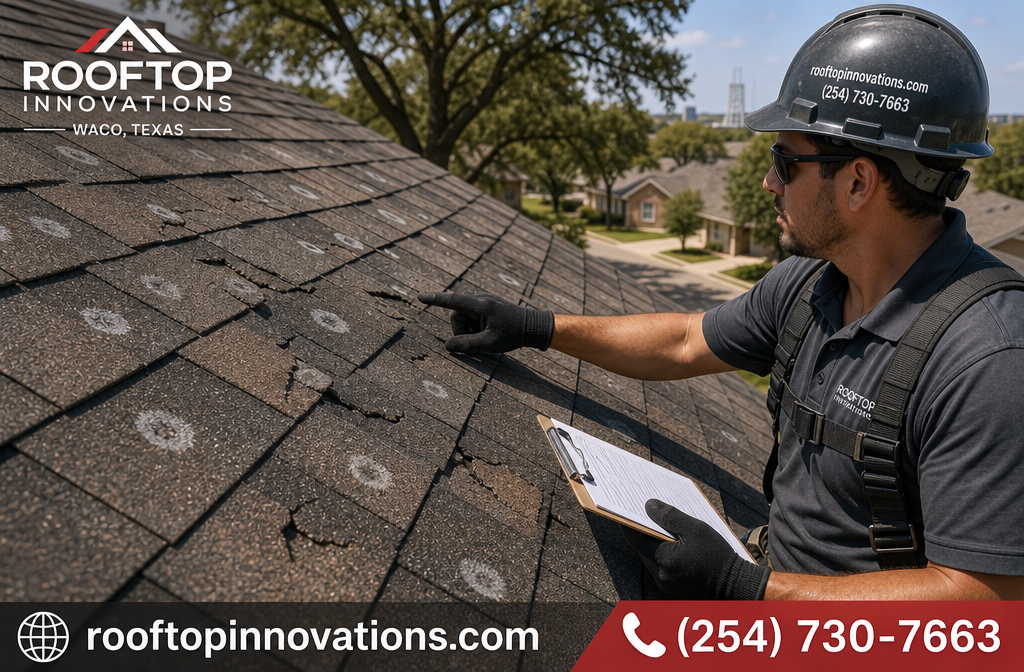
Central Texas roofs face a specific set of threats driven by the region’s hot summers, severe spring storms, and occasional ice events. The most common problems Waco roofers encounter are hail damage, wind-lifted shingles, thermal cracking, and moisture intrusion around penetrations.
Here’s what to watch for:
- Hail damage. McLennan County sits in the southern end of “Hail Alley.” Hailstones bruise asphalt shingles, crack tiles, and dent metal panels. Damage isn’t always visible from the ground, which is why a professional inspection matters after any significant storm.
- Wind damage. Straight-line winds during spring and summer thunderstorms peel back shingle tabs and expose underlayment. Even a few missing shingles can lead to leaks within days.
- UV degradation. Waco averages over 230 sunny days per year. Prolonged UV exposure dries out asphalt shingles, causing them to curl, crack, and lose granules faster than roofs in cooler climates.
- Poor attic ventilation. Inadequate ventilation traps heat in the attic (temperatures can exceed 150°F in a Waco summer), accelerating shingle deterioration from below.
- Flashing failures. The sealant around chimneys, skylights, and vent pipes breaks down in Texas heat. Once it cracks, water finds a path inside.
- Clogged gutters and drainage issues. Live oak pollen, pecan leaves, and debris from Central Texas trees clog gutters and cause water to pool, especially on flat commercial roofs.
For storm-specific concerns, our storm damage roof repair resource covers what to do immediately after severe weather.
How Do I Know if My Roof Needs Replacement or Just Repair?
A repair is usually sufficient if the damage is limited to a small area (under 30% of the roof surface), the underlying decking is sound, and the roof is less than 15 years old. A full replacement makes more financial sense when damage is widespread, the roof is nearing the end of its expected lifespan, or you’re seeing recurring leaks in multiple locations.
Choose repair if:
- Only a few shingles are missing or cracked
- The leak is isolated to one penetration point (vent, chimney, skylight)
- The roof is under 10 years old and structurally solid
- Your insurance adjuster approves a repair scope
Choose replacement if:
- More than 30% of shingles show granule loss, curling, or cracking
- You’ve had multiple repairs in the past two years
- Decking (plywood or OSB underneath) is rotting or sagging
- The roof is 20+ years old with asphalt shingles
- You’re seeing daylight through the attic or widespread water stains on ceilings
If you’re unsure, a free roof inspection from a qualified Waco roofer can give you a clear answer. A good inspector will take photos, measure remaining shingle life, and provide an honest recommendation rather than pushing you toward the most expensive option.
Metal Roof vs. Shingle Roof: Which Is Better for Waco Weather?
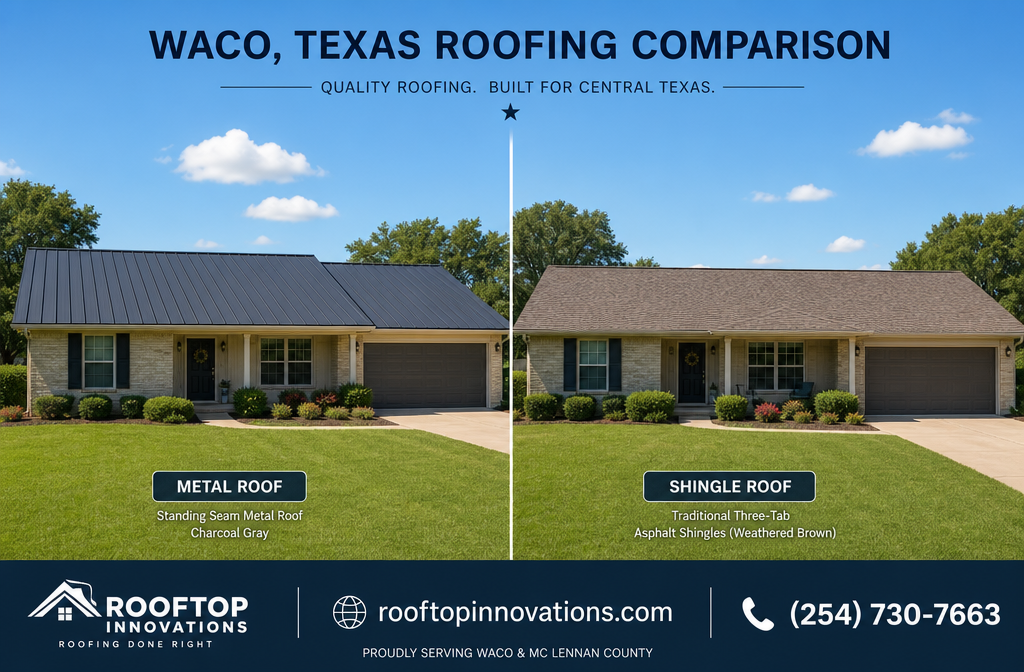
For Waco’s climate, metal roofs outperform asphalt shingles in longevity and energy efficiency, but shingles remain the more affordable upfront choice and work well for homeowners who plan to sell within 10 to 15 years.
| Factor | Asphalt Shingles | Standing Seam Metal |
|---|---|---|
| Upfront cost (2,000 sq ft home) | $7,000 – $15,000 | $12,000 – $25,000 |
| Expected lifespan in Waco | 15 – 25 years | 40 – 60 years |
| Hail resistance | Moderate (impact-rated options available) | High (dents but rarely punctures) |
| Wind resistance | Up to 130 mph (architectural) | Up to 140+ mph |
| Energy efficiency | Standard | Reflects more solar heat; can reduce cooling costs by 10–25% |
| Maintenance | Moderate | Low |
| Insurance discounts | Varies | Often qualifies for premium discounts in Texas |
Choose metal if you plan to stay in your home long-term, want lower maintenance, and can afford the higher initial investment. The energy savings alone can be significant given Waco’s long, hot summers.
Choose shingles if budget is the primary concern, you prefer a traditional aesthetic, or you’re preparing the home for sale and want maximum curb appeal at a lower cost.
Edge case: If your home is in a heavily wooded area (common near Lake Waco or along the Bosque River), falling branches can dent metal panels. Impact-resistant architectural shingles rated Class 4 may be a better fit in that situation.
What Roof Materials Work Best in Waco’s Climate?
The best roof materials for Waco balance heat resistance, hail durability, and cost. Asphalt architectural shingles (especially Class 4 impact-rated), standing seam metal, and stone-coated steel are the top three choices for residential properties. For commercial buildings, TPO, modified bitumen, and spray polyurethane foam (SPF) perform well on flat and low-slope roofs.
Residential options:
- Architectural shingles (Class 4 impact-rated): Best balance of cost and performance. Many Texas insurers offer premium discounts for impact-rated shingles.
- Standing seam metal: Excellent for heat reflection and longevity. Ideal for homeowners who want a 40+ year roof.
- Stone-coated steel: Combines the look of tile or shingles with the durability of metal. Good hail resistance.
- Clay or concrete tile: Beautiful and long-lasting but heavy; your home’s structure must support the weight.
Commercial options:
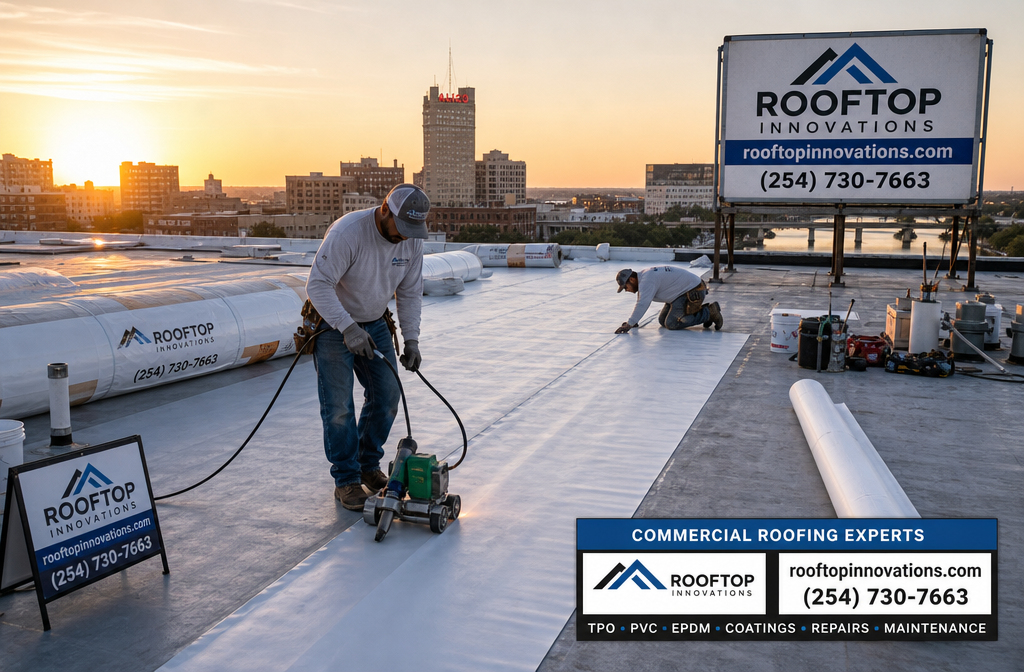
- TPO (Thermoplastic Polyolefin): Energy-efficient white membrane that reflects UV. Popular for flat commercial roofs in Waco.
- Modified bitumen: Multi-layer system that handles Texas heat well. Good for buildings with foot traffic on the roof.
- SPF (Spray Polyurethane Foam): Provides insulation and waterproofing in one application. Learn more about SPF roofing systems for commercial properties.
For businesses needing flat roof expertise, our commercial roofing services page covers available systems and warranty options.
How Storm Damage Affects Roofing in Central Texas
Central Texas averages several severe thunderstorm events per year, and McLennan County has been included in multiple federal disaster declarations over the past decade due to hail and tornado activity. Storm damage is the single most common reason Waco homeowners and business owners need roof work.
What happens during a storm:
- Hail strips granules from shingles, cracks tiles, and creates impact marks that weaken the roof’s waterproof barrier. Damage may not leak immediately but will shorten the roof’s remaining life by years.
- High winds lift shingle edges, break seals, and can tear entire sections off. Flat commercial roofs are especially vulnerable to wind uplift at edges and corners.
- Driven rain exploits any gap, no matter how small. Even a single missing shingle tab can allow gallons of water into the attic during a heavy downpour.
What to do after a storm:
- Document visible damage with photos from the ground (don’t climb on a wet roof).
- Call your insurance company to open a claim.
- Contact a Waco storm damage repair specialist for an inspection before the adjuster arrives.
- Get a written damage report from your roofer to share with the adjuster.
Common mistake: Waiting too long after a storm to file a claim. Most Texas homeowners insurance policies require prompt reporting. Delaying can give the insurer grounds to deny coverage.
What Insurance Covers Roof Damage in Texas?
Most standard Texas homeowners insurance policies (HO-3 form) cover roof damage caused by sudden, accidental events like hail, wind, falling trees, and fire. They do not cover damage from normal wear and tear, neglected maintenance, or gradual deterioration.
Key details Texas homeowners should know:
- Deductibles. Many Texas policies use a percentage-based wind/hail deductible (often 1% or 2% of the home’s insured value) rather than a flat dollar amount. On a home insured for $300,000, a 2% deductible means $6,000 out of pocket before coverage kicks in.
- Actual Cash Value vs. Replacement Cost. ACV policies deduct depreciation, so an older roof gets a smaller payout. Replacement Cost Value (RCV) policies pay the full cost to replace with equivalent materials. Check your declarations page to know which you have.
- Cosmetic damage exclusions. Some newer Texas policies exclude “cosmetic” hail damage to metal roofs (dents that don’t affect function). Read your policy carefully or ask your agent.
- Claim timeline. Texas Insurance Code requires insurers to acknowledge a claim within 15 days and accept or deny it within a reasonable timeframe (typically 15 to 45 business days after receiving all documentation).
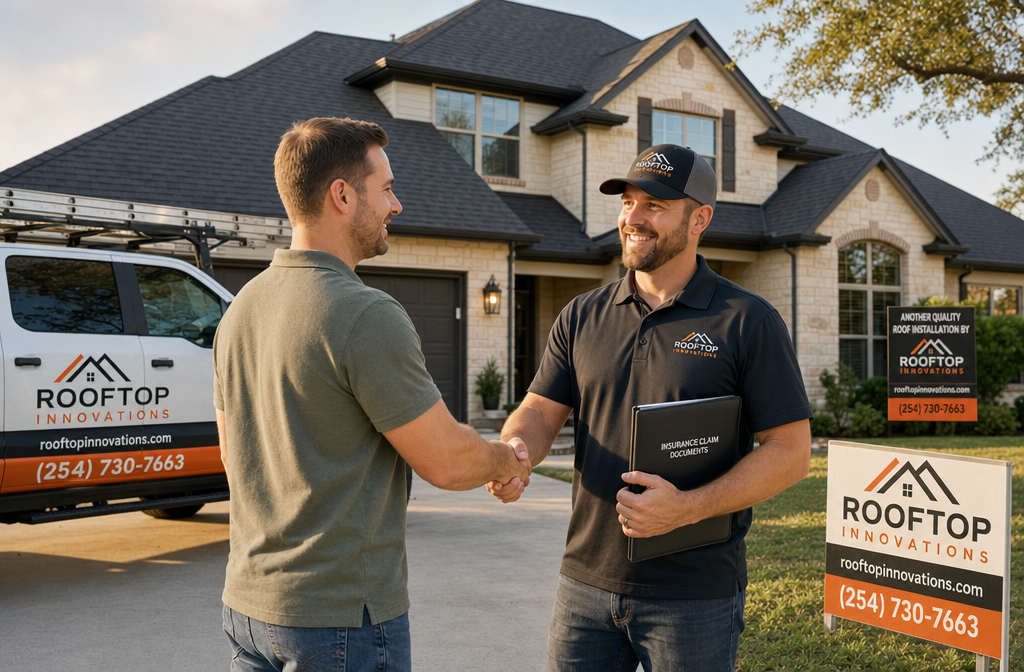
A reputable Waco roofing company will work directly with your insurance adjuster, provide detailed documentation with photos and measurements, and help ensure nothing is missed. Our insurance claims assistance page explains how that process works step by step.
What Should I Look for When Hiring a Roofing Contractor?
Hire a Waco roofer who is licensed in Texas, carries both general liability insurance and workers’ compensation, provides a written warranty on labor, and has verifiable local references in McLennan County.
Here’s a checklist:
- Texas contractor credentials. While Texas doesn’t require a state-wide roofing license, reputable contractors carry relevant certifications (GAF Master Elite, CertainTeed SELECT ShingleMaster, etc.) and register with local municipalities where required.
- Insurance verification. Ask for a Certificate of Insurance (COI) showing current general liability ($1 million minimum) and workers’ comp. If a worker is injured on your property and the contractor lacks workers’ comp, you could be liable.
- Written estimate with line items. Materials, labor, tear-off, disposal, permits, and warranty terms should all be spelled out. Vague “lump sum” bids are a red flag.
- Local presence. A Waco roofing company with a physical office or established local team is far more accountable than a storm chaser who follows hail events from state to state. Storm chasers often disappear before warranty claims arise.
- Online reviews and references. Check Google Business Profile reviews, BBB ratings, and ask for three recent local references you can call.
- Warranty details. Understand the difference between the manufacturer’s material warranty (typically 25 to 50 years) and the contractor’s workmanship warranty (varies widely; look for at least 5 years).
Decision rule: If a contractor asks for full payment upfront, won’t provide proof of insurance, or pressures you to sign immediately after a storm, walk away. Legitimate Waco roofers don’t operate that way.
For more on what sets a quality contractor apart, visit our best roofing company in Waco overview.
Best Roofing Companies Near Me in Waco: What “Best” Actually Means
The best roofing company in Waco isn’t necessarily the cheapest or the one with the biggest ad budget. It’s the one that matches your specific project type (residential shingle, commercial flat roof, metal, etc.), communicates clearly, and stands behind the work with enforceable warranties.
When evaluating the best Waco roofer for your project, weigh these factors:
- Specialization. Some companies excel at residential re-roofs but lack commercial flat roof experience. If you need a Waco commercial roofing company, confirm they have TPO, EPDM, or modified bitumen installation experience and manufacturer certifications.
- Response time. After a major storm, demand for roofers spikes. Companies with larger local crews can start sooner.
- Transparency. The best roofer in Waco will show you exactly what’s wrong, explain your options, and let you decide without high-pressure tactics.
- Community roots. Contractors who live and work in the Waco area, including surrounding towns like Valley Mills, Crawford, McGregor, Hillsboro, and Bruceville-Eddy, have a reputation to protect. That accountability matters.
Whether you’re in Bruceville-Eddy looking for a local roofer, need a McGregor residential roofing company, or require a McGregor commercial roofing company for a warehouse project, Waco-based contractors with regional reach can serve these communities efficiently.
Average Lifespan of Residential Roofs in Waco
In Waco’s climate, asphalt shingle roofs typically last 15 to 25 years, while metal roofs can last 40 to 60 years. The actual lifespan depends on material quality, installation workmanship, attic ventilation, and how many severe storms the roof endures.
Lifespan by material in Central Texas conditions:
| Material | Expected Lifespan |
|---|---|
| Three-tab asphalt shingles | 12 – 18 years |
| Architectural asphalt shingles | 18 – 25 years |
| Standing seam metal | 40 – 60 years |
| Stone-coated steel | 30 – 50 years |
| Clay/concrete tile | 40 – 75 years |
| TPO (commercial) | 15 – 25 years |
| Modified bitumen (commercial) | 15 – 20 years |
What shortens roof life in Waco:
- Repeated hail impacts (even small hail degrades shingles over time)
- Poor attic ventilation trapping excessive heat
- Deferred maintenance (ignoring small leaks, clogged gutters, damaged flashing)
- Improper installation (the number one cause of premature failure, regardless of material)
If your roof is approaching these age ranges, schedule a professional roof inspection to assess remaining life before problems start.
Can I Get a Free Roof Inspection in Waco?
Yes. Many established Waco roofing companies offer free roof inspections, especially after storm events. A free inspection typically includes a visual assessment of shingles, flashing, gutters, and penetrations, along with photos documenting any damage found.
What to expect during a free inspection:
- The inspector walks the roof (if safely accessible) and photographs all areas of concern.
- They check the attic for signs of leaks, inadequate ventilation, or daylight showing through the decking.
- You receive a written report, usually within 24 to 48 hours, with findings and recommended next steps.
- There’s no obligation to hire that company for repairs.
When to request one:
- After any hailstorm or severe wind event
- If you notice water stains on interior ceilings or walls
- Before buying or selling a home
- If your roof is over 15 years old and hasn’t been inspected recently
Be cautious of: Inspectors who “find” damage that conveniently requires a full replacement on every roof they look at. Get a second opinion if the recommendation seems excessive relative to the roof’s age and visible condition.
Emergency Roof Repair Services in Waco, Texas
When a storm tears off shingles or a tree limb punctures your roof, you need same-day service to prevent interior water damage. Several Waco roofers offer 24/7 emergency response, which typically involves tarping the damaged area to stop active leaks, then scheduling a permanent repair once conditions allow.
Emergency repair process:
- Call immediately. Don’t wait until morning if water is entering your home or business.
- Temporary tarping. The crew secures a heavy-duty tarp over the damaged section. This is a temporary measure, not a permanent fix.
- Documentation. The roofer photographs all damage for your insurance claim.
- Permanent repair scheduling. Once the insurance process begins, the contractor schedules the full repair or replacement.
Cost note: Emergency tarping typically runs $200 to $500 depending on the area covered. Most insurance policies reimburse this as part of the claim under “emergency mitigation.”
For West Texas properties and areas outside the immediate Waco metro, response times may be slightly longer, but regional contractors based in Waco regularly serve the broader Central Texas corridor.
Waco Roofing Company Services for Surrounding Communities
Waco-based roofing contractors don’t just serve the city limits. The best Waco roofer typically covers a 30- to 45-mile radius, including:
- Valley Mills – A small community west of Waco where many homes have aging roofs that need inspection after recent storm seasons. A Valley Mills roofing company is often a Waco-based team with regional reach.
- Crawford – Located southwest of Waco, Crawford homeowners benefit from the same contractor pool. A Crawford roofing company familiar with rural property access and metal building roofs is ideal.
- McGregor – Both residential and commercial properties in McGregor are served by Waco roofers. Whether you need a McGregor residential roofing company for a shingle replacement or a McGregor commercial roofing company for a warehouse, look for contractors who’ve completed projects in the area.
- Hillsboro – North of Waco in Hill County, Hillsboro residents can access Waco’s larger contractor market for competitive pricing. A Hillsboro roofing company with Waco roots often provides better warranty support than distant providers.
- Bruceville-Eddy – South of Waco along I-35, this community is well within the service area of most Waco roofers. A Bruceville-Eddy roofing company or Bruceville-Eddy roofer is typically a Waco-based contractor who serves the corridor.
Regardless of your specific location in McLennan County or surrounding areas, confirm that the contractor you hire will honor their warranty at your address and has completed similar projects nearby. Visit our Waco and Central Texas location page for service area details.
Frequently Asked Questions
How long does a roof replacement take in Waco?
Most residential roof replacements in Waco take one to three days, depending on the size of the home, material chosen, and weather conditions. Commercial projects can take one to three weeks.
Do I need a permit for roof replacement in Waco?
Yes. The City of Waco typically requires a building permit for roof replacements. Your roofing contractor should handle the permit application as part of the project.
Can I repair just part of my roof?
Yes, partial repairs are common and appropriate when damage is localized. However, if the existing shingles are discontinued or heavily weathered, color matching can be difficult, and a full replacement may look better and last longer.
What is a roofing square?
A roofing square equals 100 square feet. Contractors price materials and labor per square. A typical Waco home has 20 to 30 squares of roof area.
How do I find the best roofer in Waco?
Start by checking Google reviews, verifying insurance and credentials, and getting at least three written estimates. Ask each contractor for local references and photos of completed projects similar to yours.
Is a metal roof too loud in rain?
Modern metal roofs installed over solid decking and underlayment are no louder than shingle roofs during rain. The “tin roof” noise association comes from older agricultural buildings without insulation.
What’s the difference between a Waco commercial roofing company and a residential one?
Commercial roofing involves flat or low-slope systems (TPO, EPDM, modified bitumen, SPF) and often requires different equipment, certifications, and crew expertise than steep-slope residential work. Some companies, like those offering commercial roof repair in Waco, handle both.
Will my homeowners insurance go up if I file a roof claim?
It’s possible. Texas insurers can increase premiums or non-renew policies after claims. However, if storm damage is legitimate and widespread in your area, rate increases are often modest. Consult your agent before filing to understand the implications for your specific policy.
How often should I have my roof inspected?
At minimum, once per year and after every major storm. Regular inspections catch small problems before they become expensive repairs.
Can I install a new roof over my existing shingles?
Texas building codes generally allow one layer of new shingles over an existing layer. However, a tear-off (removing the old layer first) is almost always recommended because it allows inspection of the decking and provides a cleaner, longer-lasting installation.
What is Waco roof replacement cost for a two-story home?
Two-story homes cost 10% to 25% more than single-story homes of the same square footage due to increased labor difficulty and safety requirements. For a 2,500-square-foot two-story home, expect $9,000 to $18,000 for architectural shingles. See our Waco roof replacement page for more detail.
Do Waco roofers offer financing?
Many do. Common options include 12-month same-as-cash plans, low-interest installment loans, and insurance claim payment coordination where the contractor begins work and you pay as insurance disbursements arrive.
Conclusion
Your roof is the most critical barrier between your home or business and Central Texas weather. Whether you’re dealing with hail damage in Waco, need a commercial flat roof repaired in McGregor, or want to compare metal versus shingle options for a new build in Crawford, the right Waco roofing company makes all the difference.
Your next steps:
- Schedule a free inspection if your roof is over 10 years old or you’ve experienced recent storms. Don’t wait for a leak to appear inside.
- Get three written estimates from licensed, insured Waco roofers. Compare line items, not just bottom-line prices.
- Check credentials and reviews. Verify insurance, ask for local references, and read recent Google reviews.
- Understand your insurance policy. Know your deductible type, whether you have ACV or RCV coverage, and your claim filing deadline.
- Don’t delay storm damage claims. Prompt action protects both your roof and your coverage eligibility.
Central Texas roofs take a beating. But with the right contractor, the right materials, and proactive maintenance, your roof can protect your property for decades. If you’re ready to get started, contact a trusted Waco roofing company to schedule your inspection today.